
Stainless Steel Heat Exchanger Tubes, U-Tubes, Corrugated Tubes, and Low-Finned Tubes—Core Support in Industrial Heat Exchange
In the field of industrial heat exchange, special tubing materials such as stainless steel heat exchanger tubes, U-tubes, corrugated tubes, and low-finned tubes are key components ensuring efficient energy utilization and stable equipment operation. These tubes, through their unique structural designs or material properties, play an irreplaceable role in industries such as chemical, power, petroleum, and refrigeration. This article will delve into the professional value of these four types of tubes from four dimensions: technical characteristics, application scenarios, production innovation, and industry trends.
I. Technical Characteristics and Core Advantages
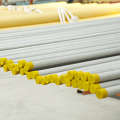
Stainless Steel Heat Exchanger Tubes: Primarily made of austenitic stainless steel such as 304 and 316L, they possess excellent corrosion resistance, high-temperature resistance, and mechanical strength. Their smooth inner walls reduce fluid resistance, and their precision-machined outer walls can be adapted to various heat exchanger structures, making them widely used in boilers, condensers, evaporators, and other equipment. For example, in seawater desalination systems, stainless steel heat exchanger tubes can effectively resist chloride ion corrosion, extending equipment life.
U-tubes: Formed into a U-shape through a bending process, these tubes allow for a compact heat exchanger layout without welding. Their advantage lies in eliminating the risk of weld leaks, making them suitable for high-pressure, high-temperature, or vibrating environments, such as nuclear power plant steam generators and high-pressure heaters. Precise control of the bending radius of U-tubes is crucial in production, requiring CNC bending machines to ensure geometric consistency of each tube.
Corrugated tubes: These tubes undergo a special rolling process to create a periodic corrugated structure on the tube wall, significantly increasing surface area and turbulence intensity, thus enhancing heat transfer efficiency. The corrugation depth and pitch parameters can be customized according to the medium characteristics, making them commonly used in air preheaters, waste heat recovery devices, and other applications requiring enhanced heat transfer. Their high-temperature oxidation resistance is also superior to ordinary smooth tubes, making them suitable for high-temperature flue gas heat exchange.
Low-finned tubes: These tubes have helical or serrated fins machined onto the outer wall of the smooth tube, increasing heat transfer area and improving efficiency. Low-finned tubes are particularly suitable for low-flow-rate, high-temperature-difference conditions, such as air conditioning condensers and heat pump evaporators. The connection strength between the fins and the base tube must be ensured through high-frequency welding or mechanical expansion to prevent fin detachment during operation.
II. Application Scenarios and Industry Cases
In the petrochemical industry, stainless steel heat exchange tubes are used in the convection section of cracking furnaces and cooling systems of hydrogenation reactors, withstanding high temperatures, high pressures, and corrosive media. U-shaped tubes are used as conversion furnace tubes in ammonia synthesis plants, utilizing their seamless characteristics to ensure long-term sealing. Corrugated tubes are used in waste heat boilers in steel plants to recover heat from blast furnace gas, while low-finned tubes improve energy efficiency ratios in data center cooling systems.
For example, in a large chemical plant, after using corrugated tubes to modify the air cooler, the heat transfer coefficient increased by 30%, saving over ten million yuan in steam costs annually. In the new energy field, low-finned tubes are used in the thermal storage units of photovoltaic and solar thermal power generation systems, contributing to the efficient conversion of renewable energy.
III. Production Innovation and Quality Control
Professional production of these special tubes requires mastery of core technologies such as precision cold rolling, CNC bending, laser welding, and high-frequency fin welding. For example, corrugated tube production requires multi-pass rolling forming, coupled with online inspection to ensure corrugation uniformity; the fin forming of low-finned tubes requires controlling fin height and fin spacing tolerances within ±0.1mm, and pressure testing to verify pressure resistance.
In terms of materials, higher purity base materials are used, combined with solutions treatment, pickling, and passivation processes to improve corrosion resistance. Full-process quality traceability is implemented during production, with strict standards for each step from raw material inspection to finished product testing. For example, U-shaped tubes require hydraulic testing and intergranular corrosion testing to ensure safety and reliability under extreme operating conditions.
IV. Industry Trends and Future Outlook
With the advancement of the “dual carbon” target, the demand for high-efficiency, energy-saving, and long-life heat exchanger tubes continues to grow. In the future, new composite coating technologies will further improve the corrosion resistance of stainless steel heat exchanger tubes; 3D printing technology may be applied to the customized production of complex structure tubes; intelligent monitoring systems can provide real-time feedback on tube operating status, enabling predictive maintenance.
Driven by environmental policies, the application of low-finned tubes in waste heat recovery and new energy storage will be further expanded; corrugated tubes are expected to play a key role in emerging industries such as hydrogen energy and CCUS (carbon capture and storage). Meanwhile, the industry is moving towards lightweighting, modularization, and intelligentization, reducing material consumption and improving system energy efficiency through optimized design.
Conclusion: As core components of industrial heat exchange, the technological advancements in stainless steel heat exchange tubes, U-tubes, corrugated tubes, and low-finned tubes directly drive improvements in energy utilization efficiency. Professional manufacturers need to continuously innovate processes and strictly control quality to meet the demands of various industries for efficient, reliable, and environmentally friendly heat exchange solutions. With breakthroughs in new materials and processes, these special tubes will play an even more important role in green manufacturing and energy conservation and emission reduction.


